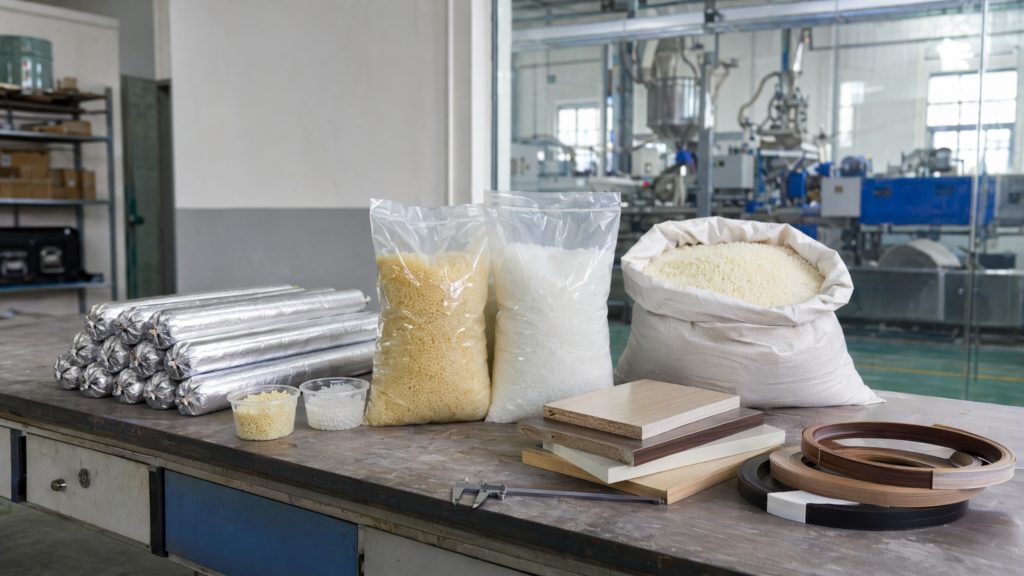
For furniture factories, edge banding is not only a finishing step. It affects board protection, appearance, rework rate, customer complaints, and the stability of downstream assembly. When buyers compare PUR hot melt adhesive and EVA hot melt adhesive, the best choice depends on substrate, machine setup, climate, required bond strength, cost target, and the final product market.
This guide is written for importers, purchasing managers, and production engineers who source adhesive for furniture edge banding, flat lamination, profile wrapping, and related woodworking applications. It is especially relevant for factories and trading companies serving Vietnam, Indonesia, and other Southeast Asian markets where heat, humidity, export packaging, and consistent technical support matter in daily production.
Quick Summary: When to Choose PUR or EVA
Choose PUR hot melt adhesive when the project needs higher moisture resistance, stronger bonding after curing, thinner glue lines, better heat resistance, or more demanding export furniture performance. PUR is often considered for high-end panels, bathroom furniture, kitchen cabinets, wrapped profiles, and products that may face humidity during storage or use.
Choose EVA hot melt adhesive when the project needs stable everyday performance, easier operation, fast line speed, wider operator familiarity, and a more economical cost structure. EVA is commonly used for standard furniture edge banding, panel processing, packaging, and general woodworking lines where the finished item does not require PUR-level moisture or heat resistance.
How PUR and EVA Hot Melt Adhesives Work
EVA hot melt adhesive bonds mainly by cooling and solidifying. It melts in the glue pot, wets the board and edge tape, then sets as the temperature drops. This makes EVA simple to use and suitable for many standard furniture factories.
PUR hot melt adhesive also sets as it cools, but then continues to react with moisture in the air and substrate. After curing, it forms a stronger crosslinked bond. This is why PUR can offer better resistance to moisture, heat, and stress. The tradeoff is that PUR requires more careful storage, equipment cleaning, and process control.
Edge Banding Selection Factors
1. Board and edge material
MDF, particle board, plywood, PVC edge banding, ABS, acrylic, veneer, and paper edge tape can behave differently. A formula that works well on one board may need adjustment on another because surface energy, porosity, dust, and primer quality all affect bonding. Before bulk purchasing, factories should test adhesive with their actual board, edge tape, primer, and machine settings.
2. Temperature and humidity
Vietnam and Indonesia furniture factories often operate in warm and humid conditions. This can be helpful for PUR curing, but it also makes storage discipline important. PUR cartridges or blocks should be protected from moisture before use. EVA is generally easier to store and handle, but finished products still need suitable adhesive selection if they will be shipped, warehoused, or used in high-humidity environments.
3. Glue line appearance
For premium furniture, a thinner and cleaner glue line can improve the final look. PUR is often selected when buyers want a finer glue line and stronger long-term bond. EVA remains practical for standard production, especially where the edge design, board quality, and application settings already produce an acceptable finish.
4. Operating window and line speed
Open time, viscosity, softening point, and application temperature should match the edge banding machine. If the adhesive sets too quickly, wetting may be poor. If it stays open too long, trimming and pressing can become unstable. A supplier should help match adhesive grade to machine speed, roller system, nozzle system, and local workshop temperature.
PUR vs EVA for Flat Lamination and Profile Wrapping
Flat lamination and profile wrapping place different stress on the adhesive layer. In flat lamination, surface flatness, film type, feed speed, and pressing pressure are important. In profile wrapping, the adhesive must support complex shapes, corners, and tension from decorative films or veneers. PUR can be valuable where high bond strength, moisture resistance, and durable wrapping performance are required. EVA may be suitable for less demanding laminating work and cost-sensitive applications.
Factories comparing both technologies can review QG Bond hot melt adhesive services for sample testing, grade matching, and process discussion before committing to container volume or long-term purchasing contracts.
Cost: Do Not Compare Only the Price per Kilogram
A lower adhesive price does not always mean a lower production cost. Buyers should compare coating weight, scrap rate, restart waste, cleaning time, product returns, and storage loss. EVA usually has a lower entry cost and simpler operation. PUR may cost more per kilogram, but for selected furniture lines it can reduce quality risk when the application truly needs its performance.
Environmental and Compliance Questions
Many importers ask about environmental compliance, odor, VOC concerns, and documents for export furniture. The right approach is to request current technical data sheets, safety data sheets, and relevant test documents for the exact adhesive grade being purchased. Avoid assuming that one adhesive family automatically satisfies every buyer requirement. Compliance should be checked by product grade, destination market, and final use case.
QG Bond can discuss adhesive selection and document needs through the contact page. Buyers should share the substrate, application, destination market, and any customer-specific requirements before asking for a recommendation.
Procurement Checklist for Importers and Factories
- Confirm the exact application: edge banding, flat lamination, profile wrapping, packaging, or mixed use.
- Share board type, edge tape material, primer status, machine brand, and line speed.
- Ask for sample quantity before bulk order evaluation.
- Test bond strength after cooling and after realistic storage conditions.
- Check glue line appearance, trimming quality, and resistance after the finished panel stabilizes.
- Review packaging format, shelf life, storage conditions, and shipping plan.
- Request technical data sheets and safety data sheets for the exact grade.
FAQ
Is PUR always better than EVA for edge banding?
No. PUR can provide stronger moisture and heat resistance, but EVA is often the practical choice for standard furniture production. The right adhesive depends on performance target, machine setup, operating discipline, and total cost.
Can one adhesive grade cover edge banding, flat lamination, and packaging?
Sometimes one grade can cover nearby applications, but it is not safe to assume. Packaging, edge banding, lamination, and profile wrapping may require different viscosity, open time, and bonding characteristics.
What should Vietnam and Indonesia buyers test first?
They should test the adhesive with local workshop temperature, humidity, actual board material, actual edge tape, and the machine settings used in normal production. Storage and shipping conditions should also be checked before repeat orders.
How should I ask for a QG Bond recommendation?
Send the application, substrate, edge or film material, machine type, line speed, expected performance, destination market, and estimated monthly usage. Start from the QG Bond homepage or contact the team directly for sample discussion.
Conclusion
PUR and EVA hot melt adhesives both have a place in furniture manufacturing. EVA is reliable and economical for many standard edge banding and woodworking lines. PUR is a stronger candidate when the finished furniture needs better moisture resistance, heat resistance, cleaner glue lines, or more demanding wrapping and lamination performance. For export buyers and factories in Southeast Asia, the best purchasing decision comes from matching adhesive chemistry to actual materials, equipment, climate, and quality expectations.
Suggested image alt text for this topic: “PUR and EVA hot melt adhesive samples for furniture edge banding”, “Furniture edge banding production using hot melt adhesive”, and “Flat lamination and profile wrapping adhesive application for woodworking panels”.