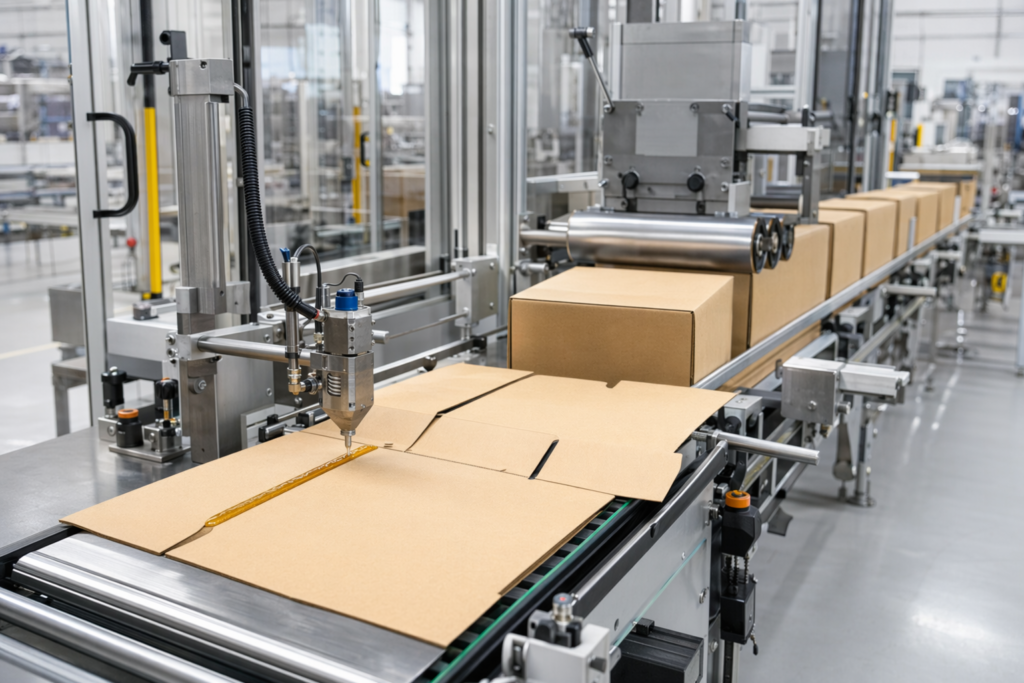
When carton flaps lift, strings trail from the nozzle, or bonds fail after cooling, the adhesive is only one possible cause. EVA hot melt adhesive carton sealing troubleshooting should also examine board surface, compression, open time, temperature, application pattern, and maintenance. This guide helps packaging buyers and factory teams diagnose recycled and coated corrugated board without changing several variables at once.
Why Recycled and Coated Board Can Be Difficult to Seal
Recycled corrugated board can vary in fiber mix, dust level, stiffness, absorbency, and surface condition between suppliers or lots. Coated or printed board may present a smoother, less absorbent surface. Varnish, ink, wax, lamination, or contamination can further change wetting and adhesion.
A carton that seals well on uncoated kraft liner may therefore need a different adhesive grade, application pattern, or compression window on a coated surface. Buyers can review QG Bond’s EVA hot melt adhesive overview before requesting a representative trial.
Start With the Failure Mode, Not the Temperature Dial
Record exactly where and when the failure occurs. Note the board supplier and lot, carton style, coating or print area, line speed, adhesive batch, melter and hose settings, bead pattern, compression time, ambient conditions, and time between sealing and inspection. Photograph both bonded surfaces after opening the joint.
- Adhesive transfers to only one flap: investigate poor wetting, a cold surface, contamination, or a closed open-time window.
- Paper fibers tear from both sides: the bond may be stronger than the board at the tested condition; confirm performance after normal storage and transport simulation.
- Bond looks acceptable when warm but opens later: check compression, carton spring-back, cooling, adhesive selection, and finished-goods exposure.
- Intermittent skips or thin beads: inspect nozzle condition, pressure, filters, feed consistency, and char before blaming the substrate.
Carton-Sealing Troubleshooting Table
| Symptom | Possible process cause | Controlled check |
|---|---|---|
| Flap opens immediately | Insufficient compression, poor bead placement, or adhesive applied outside its usable open time | Verify guides, compression duration, bead position, and timing with the normal production carton |
| Poor bond on printed or coated area | Low surface wetting or incompatible coating | Compare coated and uncoated areas while holding adhesive amount and compression constant |
| Weak bond on dusty recycled board | Loose fibers or dust interfere with contact | Inspect and document surface cleanliness; compare representative board lots |
| Stringing or tailing | Nozzle condition, application temperature, viscosity mismatch, or cutoff timing | Inspect equipment first, then adjust one validated parameter at a time |
| Char or blocked nozzle | Contamination, excessive residence time, or overheating | Review tank condition, standby procedure, temperature calibration, and maintenance records |
| Bond fails in warehouse or transit | Carton stress, temperature exposure, substrate change, or unsuitable grade | Test sealed cartons after representative conditioning and handling |
A Six-Step Line Trial for Buyers and Plant Teams
- Define acceptance criteria. Agree on sealing speed, failure mode, carton damage limits, inspection time, and storage or transport conditions.
- Collect representative substrates. Include recycled content, print, coating, board supplier, and seasonal lots used in production.
- Establish a baseline. Record the current grade, settings, bead weight or pattern, compression, output, and failure rate.
- Change one variable at a time. Do not change adhesive, temperature, bead size, and compression simultaneously.
- Inspect after conditioning. Immediate tack alone does not prove that a carton will remain closed after cooling, stacking, or humid storage.
- Approve with traceable records. Link the adhesive batch, board lot, equipment settings, trial date, and result.
Temperature, Open Time, and Compression
Use the application range supplied for the exact adhesive grade and verify actual temperature with maintained equipment. Raising the setpoint can increase degradation risk and does not correct every wetting or mechanical problem. A lower-than-expected temperature at the nozzle may also result from a sensor, hose, or flow issue.
The carton flaps must meet while the adhesive can still wet the second surface, then remain under suitable compression as the bond develops. Faster lines, long distances between application and closing, stiff recycled board, and spring-back can reduce the effective process window. Measure timing and compression instead of relying on the nominal machine speed alone.
Procurement Questions Before Selecting an EVA Grade
- Which liner, recycled-content range, print, varnish, or coating must be bonded?
- What are the line speed, application method, bead pattern, and compression arrangement?
- What hot melt equipment and operating range are available?
- What finished-carton temperatures, stacking loads, storage periods, and transport routes are expected?
- Which technical data, safety data, shelf-life information, and destination-specific compliance documents are required?
- How will trial results and later substrate changes be controlled?
QG Bond’s hot melt adhesive services describe application-matching support. Send representative board details and operating conditions through the contact page, or visit the QG Bond homepage to review the wider PUR and EVA range.
Vietnam and Indonesia: Humidity and Substrate Control
Packaging plants in Vietnam and Indonesia may receive board across rainy and dry seasons and store it in warm, non-air-conditioned areas. Humidity can affect board stiffness, flatness, and carton spring-back, while transport and storage can introduce dust or condensation risks. These conditions should be documented as process variables rather than used to assume one universal adhesive setting.
For approval trials, use board from the actual supplier and include challenging printed or coated zones. Condition and test sealed cartons under representative factory and distribution conditions. If a board supplier, coating, or recycled-content range changes, run a controlled confirmation instead of assuming the previous result still applies.
Frequently Asked Questions
Why does hot melt adhesive stick to kraft board but not coated board?
A coating, varnish, ink, film, or contamination can change surface energy and wetting. Compare the actual coated and uncoated areas in a controlled trial, and share the coating details with the adhesive supplier. Do not assume that increasing temperature alone will make the materials compatible.
Should we increase application temperature when cartons open?
Not before checking the failure mode, actual nozzle temperature, open time, bead placement, compression, substrate, and equipment condition. Use only the validated range for the selected grade. Excess heat can increase odor, char, maintenance, and degradation risk.
How should we test recycled corrugated board?
Test representative lots at normal line speed and settings, record surface condition and recycled-content information where available, and inspect both immediate and conditioned bonds. Include realistic stacking, storage, and transport exposure in the acceptance plan.
What sample information does an adhesive supplier need?
Provide actual board samples, coating or print details, current adhesive and settings, equipment type, line speed, bead pattern, compression, failure photos, finished-carton requirements, and destination conditions. This is more useful than requesting a grade based only on carton weight.
Conclusion
Effective EVA hot melt adhesive carton sealing troubleshooting separates substrate, adhesive, equipment, and process variables. Define the failure mode, record a baseline, test representative recycled or coated board, and change one parameter at a time. A traceable line trial gives procurement and production teams a stronger basis for grade approval than a short manual pull test.