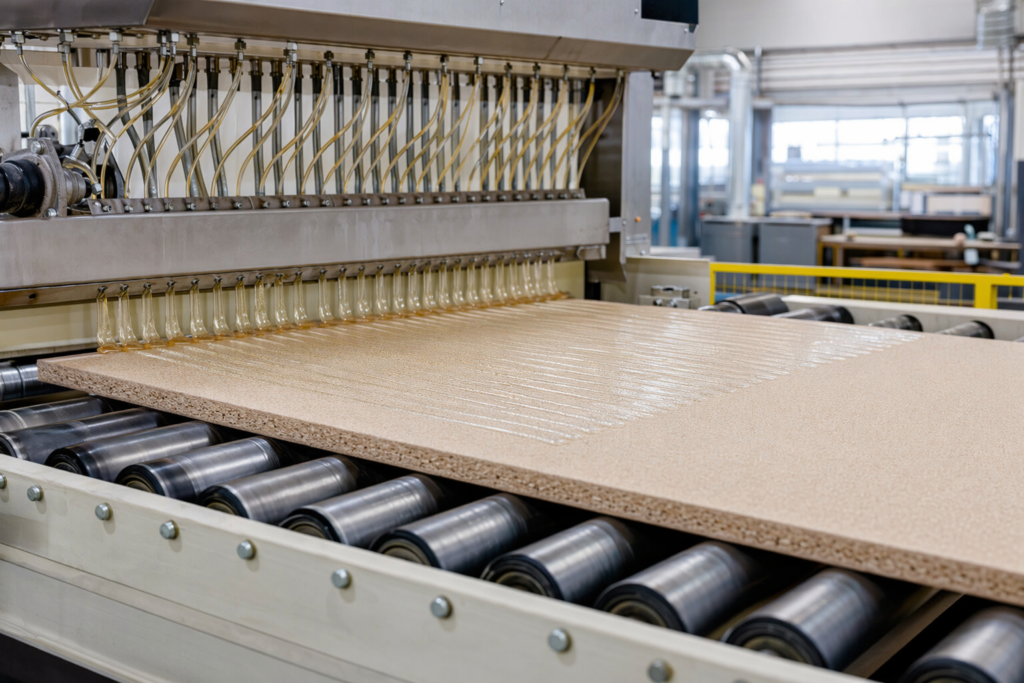
PUR hot melt adhesive develops handling strength as it cools, then builds final performance through a moisture-curing reaction. For furniture factories, the key is not simply waiting for a fixed number of hours. PUR hot melt adhesive curing process control requires a defined application window, stable substrates, controlled moisture exposure, protected adhesive handling, and staged bond testing. This guide gives procurement and production teams a practical framework for line trials and supplier approval.
How PUR Hot Melt Adhesive Curing Works
PUR hot melt adhesive is applied in a molten state. Initial strength develops as the adhesive cools and holds the parts together. A later chemical reaction with available moisture increases heat, moisture, and chemical resistance, depending on the exact grade, substrates, coat weight, and process conditions.
Initial handling strength and final cured performance are therefore different approval points. A panel may be ready to move or trim but still be unsuitable for a demanding heat or moisture test. Buyers should review the QG Bond PUR hot melt adhesive range and confirm the technical instructions for the specific grade rather than applying one universal cure schedule.
Five Variables That Control the PUR Cure Process
- Adhesive temperature: use the validated operating range and verify actual temperature at the application point. Excessive heat can increase degradation risk.
- Substrate temperature and condition: cold, wet, dusty, oily, or contaminated surfaces can reduce wetting and bond consistency.
- Coat weight and coverage: too little adhesive may leave incomplete contact; too much can affect cost, squeeze-out, cooling, and curing behavior.
- Open time, assembly, and pressure: parts must meet while the adhesive can wet the second surface and remain in suitable contact as initial strength develops.
- Moisture and conditioning: humidity, substrate moisture, adhesive thickness, and bond geometry can influence the curing rate. Follow grade-specific guidance and validate with representative parts.
PUR Hot Melt Adhesive Process Control Table
| Control point | What to record | Why it matters |
|---|---|---|
| Incoming materials | Substrate supplier, lot, surface, moisture condition, adhesive batch | Separates material changes from process changes |
| Application | Melter, hose and head settings, line speed, coat weight or spread, open time | Confirms that the trial represents normal production |
| Assembly | Pressure, nip or clamp setting, part temperature, alignment | Supports wetting and stable initial contact |
| Early inspection | Handling time, appearance, squeeze-out, immediate failure mode | Detects line problems without claiming full cure |
| Conditioned inspection | Elapsed time, temperature, humidity, test method, failure mode | Links performance to a defined curing stage |
| Release decision | Acceptance limits, approver, retained samples, traceability | Creates a repeatable procurement and production standard |
A Controlled Trial From Sample to Production
- Define the application. Identify the substrate pair, surface finish, part geometry, line speed, downstream handling, and final service conditions.
- Agree on acceptance criteria. Specify handling strength, appearance, destructive bond result, heat or moisture exposure, and the time of each inspection.
- Establish a baseline. Record current adhesive, settings, coat weight, pressure, output, scrap, and known failure rate.
- Run representative material. Include actual production lots, difficult surfaces, edge zones, profiles, and seasonal substrate variation.
- Change one variable at a time. Do not change adhesive grade, temperature, speed, spread, and pressure simultaneously.
- Inspect in stages. Check early handling, an agreed intermediate point, and final conditioned performance. Record the failure surface, not only pass or fail.
- Confirm on production scale. Repeat the selected window during a longer run and include start-up, steady production, planned stops, and restart.
Moisture, Humidity, and Tropical Factory Conditions
Factories in Vietnam and Indonesia can experience warm, humid conditions and significant differences between rainy and dry seasons. Humidity may support the moisture-curing reaction, but uncontrolled conditions do not automatically produce a better bond. Condensation, wet substrates, open adhesive exposure, and large swings in panel temperature can create separate quality risks.
Record ambient conditions during trials and condition substrates as they would be stored in normal production. Keep unopened PUR packaging protected according to supplier instructions, limit unnecessary exposure after opening, and follow the equipment and adhesive supplier’s shutdown and cleaning procedures. Do not add water directly to the adhesive or assume that a higher humidity number can replace grade-specific validation.
Handling Opened PUR Adhesive and Production Stops
Reactive PUR adhesive can be affected by moisture exposure before application. The appropriate handling method depends on the package format, melter design, production schedule, and grade. Keep containers closed until needed, use compatible equipment, avoid mixing uncertain residues or different products, and document opening time and batch traceability.
For short stops, long stops, and end-of-shift shutdowns, use a written procedure approved for the specific equipment and adhesive. The procedure should cover temperature reduction where applicable, moisture protection, purge or cleaning material, restart checks, and disposal requirements. A generic high-temperature hold can increase residence time and degradation risk.
Procurement Questions for a PUR Adhesive Supplier
- Which substrates, coatings, primers, and surface treatments were included in the recommendation?
- What application temperature range, open time, coat weight, and pressure window should the trial begin with?
- When can parts be handled, trimmed, packed, and tested for final performance?
- Which conditioning and bond test methods are appropriate for the intended product?
- What packaging, shelf life, storage, opening, shutdown, cleaning, and safety instructions apply?
- Which technical data, safety data, and destination-specific compliance documents are available for the exact grade?
QG Bond’s technical matching services can support application discussions. Send the substrate details, production conditions, trial criteria, and destination requirements through the contact page. The QG Bond homepage also provides an overview of PUR and EVA hot melt adhesive applications.
Frequently Asked Questions
How long does PUR hot melt adhesive take to cure?
There is no reliable universal cure time. The grade, adhesive thickness, substrates, moisture availability, temperature, bond geometry, and test requirement all matter. Use supplier guidance as a starting point and approve the process with staged tests on representative production parts.
Can we pack parts as soon as the bond has cooled?
Only if the approved process shows sufficient handling strength and packing will not disturb alignment or trap conditions that affect quality. Cooling can provide early strength, but it does not prove that the moisture-curing reaction or final performance test is complete.
Does high humidity always make PUR adhesive cure better?
No. Moisture participates in curing, but excessive substrate moisture, condensation, or uncontrolled adhesive exposure can create defects. Validate the exact substrates and factory conditions, and follow the storage and processing instructions for the selected grade.
What should buyers compare during a PUR adhesive trial?
Compare the same substrates and line conditions, record coat weight and settings, inspect failure surfaces at agreed times, test relevant heat or moisture exposure, and calculate applied cost rather than price per kilogram alone. Keep retained samples and traceable batch records.
Conclusion
PUR hot melt adhesive curing process control connects material condition, application settings, moisture exposure, staged inspection, and traceable approval. Separate early handling strength from final cured performance, test representative substrates, and document a production window that operators and buyers can repeat. This approach reduces trial ambiguity and supports a more defensible adhesive selection.